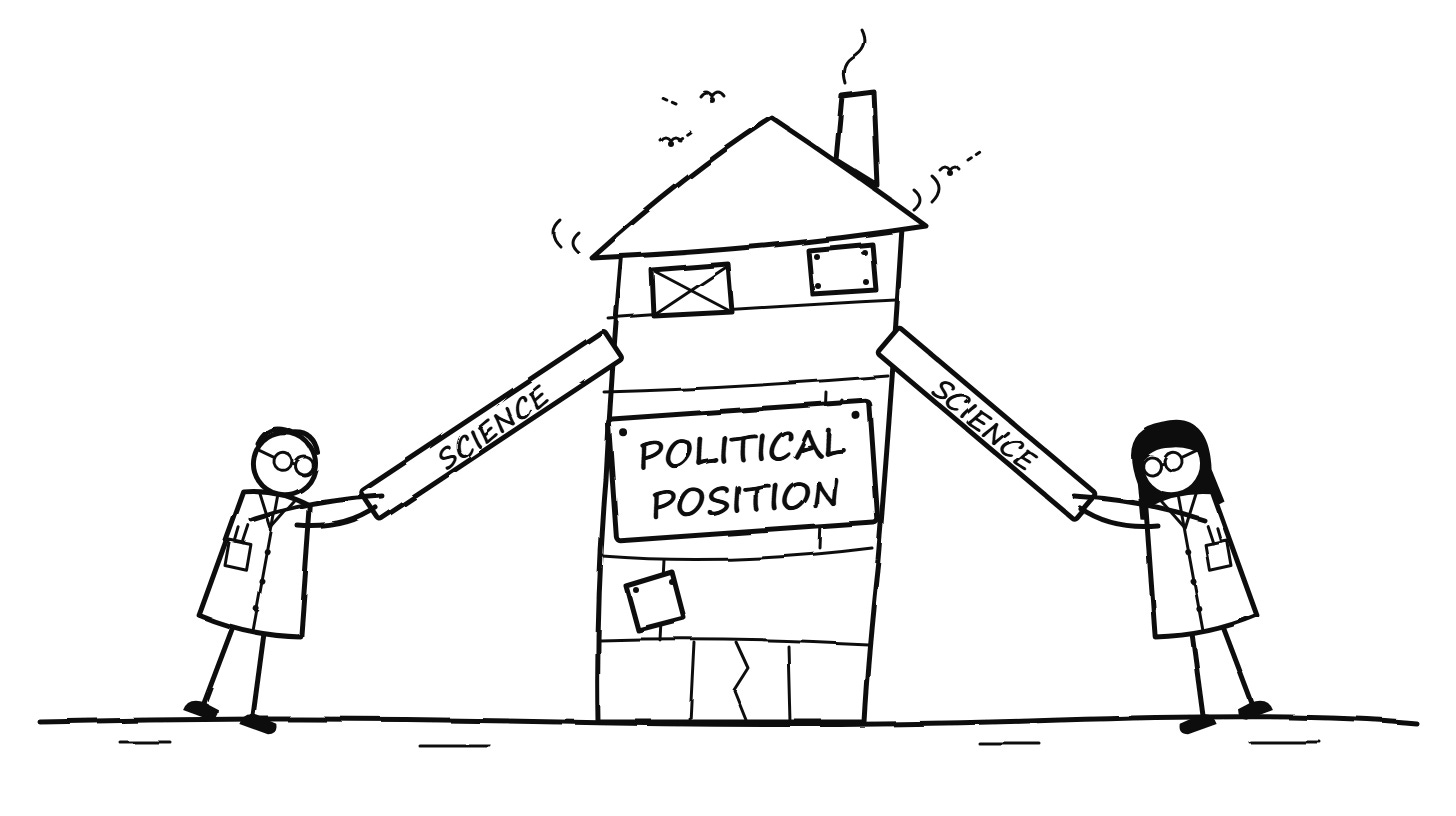
On 2 July, Dinithi Bowatte and Max Soar argued in Newsroom that NZ First’s definitions bill hides “political agency” behind a “façade of scientific authority.” On 26 August, biochemists Dr Chris Pook and Dr Julia Schaletzky replied under the title “Science is not a political prop.”
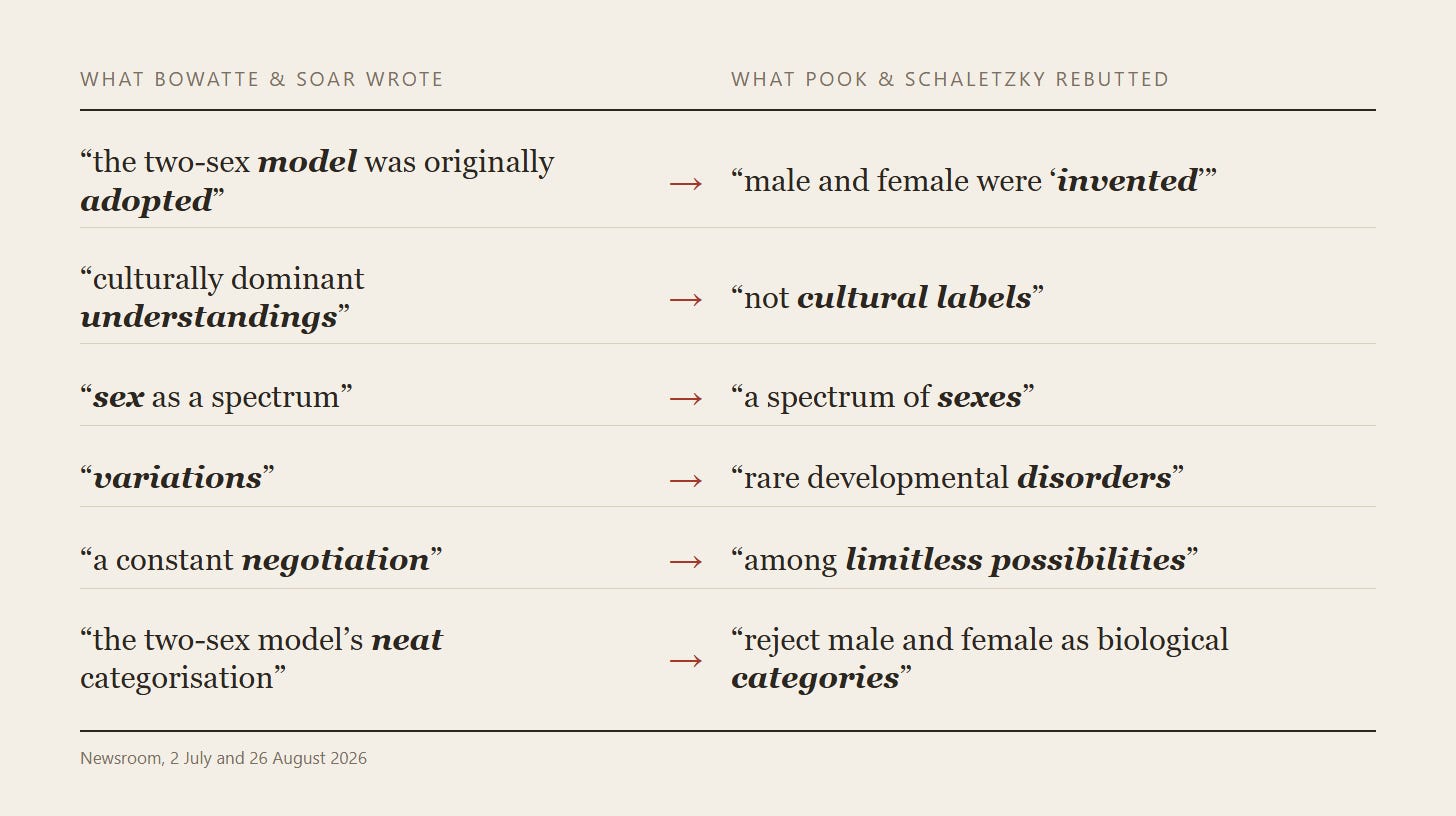
Pook and Schaletzky claim that Bowatte and Soar’s article “asks readers to believe that the two sexes are an eighteenth-century European adoption, that XX and XY chromosomes were merely ‘allocated’ to women and men, that rare developmental disorders demonstrate a spectrum of sexes, and that scientists increasingly reject male and female as biological categories.” The rest of their article then sets out to refute those four claims. The problem is, did Bowatte and Soar even make them? Let’s take a look.
1: “the two sexes are an eighteenth-century European adoption.”
Pook and Schaletzky later go further: a historical thesis “cannot establish that male and female were ‘invented’ in eighteenth-century Europe.” Bowatte and Soar wrote that “the two-sex model was originally adopted by 18th century European scientists.” A model of sex is a way of describing the sexes, not the sexes themselves. They did not claim that the two sexes were “invented” then.
2: “XX and XY chromosomes merely ‘allocated’ to women and men.”
Bowatte and Soar’s next sentence explains this: “Culturally dominant understandings assume an alignment between these chromosomes and sexual anatomy and physiology.” Pook and Schaletzky again rebut something else: “Scientists did not ‘assign’ chromosomes to social groups,” and “Chromosomes are physical structures, not cultural labels.” Bowatte and Soar did not claim chromosomes were not physical structures or that they were assigned to social groups.
3: “rare developmental disorders demonstrate a spectrum of sexes.”
Bowatte and Soar wrote that “scientists have increasingly come to understand sex as a spectrum,” and that the science of sex determination “is made up of layers – genetic, chromosomal, hormonal, anatomical, and physiological – that compete with each other at different places in the body at different points in time.” A spectrum of sex is not a “spectrum of sexes.”
Yet Pook and Schaletzky answer: “There is no third human gamete and no continuum between sperm and ovum.” “Developmental disorders do not create new sexes,” “do not create additional reproductive categories.” Bowatte and Soar never claimed a third sex, a third gamete or a new reproductive category. What they actually said was that sex characteristics vary, which Pook and Schaletzky concede in the same paragraph: “Hormones, anatomy and secondary sexual characteristics may vary.”
Other words are changed too. Bowatte and Soar wrote of variations, not “disorders,” and gave their 2.3 per cent figure for them, not for people who are “intersex.” Pook and Schaletzky then measure it against genital ambiguity at birth, which is only a subcategory of those variations. Nor did Bowatte and Soar write of “limitless possibilities”; their phrase was “a constant negotiation.”
4: “scientists increasingly reject male and female as biological categories.”
Bowatte and Soar’s sentence in full: “Scientists have increasingly come to understand sex as a spectrum, rejecting the two-sex model’s neat categorisation that the bill is now attempting to put into law.” Rejecting the neatness of a categorisation is not rejecting the existence of the categories themselves.
A Scorecard on their four claims
How are their four claims looking? A model becomes the sexes themselves. Chromosomal classification becomes an assertion that chromosomes are cultural labels. Rejecting neat categorisation becomes rejecting the categories. Variation in how different classes of sex characteristic line up becomes a claim of new sexes and a third gamete type. Pook and Schaletzky repeatedly rebut propositions different from those Bowatte and Soar actually made.
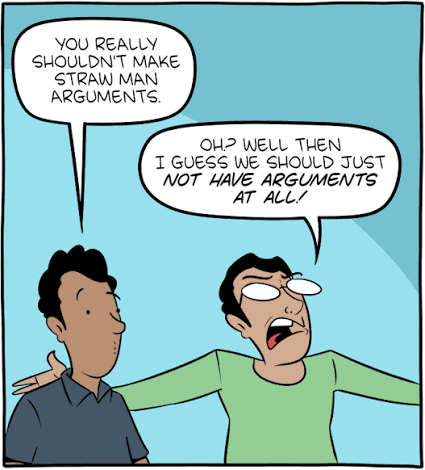
These are straw man fallacies: altered or exaggerated claims put in place of the ones actually made, so that rebutting the substitute looks like defeating the original.
The Bill Submission that UoA SEEN made
Pook and Schaletzky’s conclusion from all this is that what Bowatte and Soar “cannot legitimately claim is that basic biology has discovered sex to be a spectrum.” They link to a select-committee submission hosted by UoA SEEN (Sex Equality and Equity Network). UoA SEEN’s website disclaimer says it “is not a registered affiliate or formally recognised staff network of the University of Auckland.” Dr Chris Pook’s byline states he is the chair of UoA SEEN, and both Pook and Schaletzky are signatories on the submission.
The submission’s author line reads “Ad Hoc Working Group on Sex Denialism,” and the document defines the term: “assertions that support the idea that biological sexes, female and male, are not real and fixed, but instead are socially constructed impositions on a continuum or spectrum.” Bowatte and Soar did write “far from an immutable reality” and “sex as a spectrum.” They also wrote “so-called biological sex,” but the “so-called” targets the bill’s appeal to “biological reality,” and their question, “how can we know what our so-called ‘biological sex’ really is?”, follows a passage on people who do not know their own chromosomes. It asks how a legal definition would sort people, not whether sex exists. They did not write that sex is not real: their article walks typical development down to the SRY region of the Y chromosome and “a pair of testes.” Saying sex varies is filed as saying sex is unreal. The label “sex denialism” makes that substitution before the argument begins.
The submission says its signatories “do not take a position for or against the Bill as a matter of law or policy.” The same document says what “good policy should not” do across “language, data collection, medicine, sport, safeguarding, prisons, or women’s rights.” It adds: “We also do not aim to comment on ‘gender.’” Yet three of its seven listed claims are about gender identity and transition: brain scans, whether medical treatment changes sex, whether gender identity is genetic. Marcroft’s bill names gender identity too, but only to set it aside: “In any legislation, regardless of gender identity, woman means an adult human biological female.” So the UoA SEEN submission says what good policy should not do and then takes a policy position, and three points in seven on gender identity say which one.
Pook and Schaletzky’s article takes the same route from science to policy. Eleven paragraphs of biology and two of contested history arrive at this policy conclusion: “Women require sex-based protections where pregnancy, medical risk, physical performance, violence and privacy depend on biological sex rather than gender identity.” Pregnancy and medical risk depend on sex; nobody disputes it. Physical performance, violence and privacy are the contested items, and the contest is about gender identity: whether a trans woman counts as a woman in sport, in prison, in a changing room. None of those paragraphs are about gender identity, and their closing claim that ignoring the sex distinction “has already produced measurable harms, particularly for women and girls” comes with no source at all. Chromosomes and gametes cannot tell a legislature whether to recognise a person’s gender identity; that is a question about law, ethics and human rights — not cells.

This overall rhetorical structure has a name: the motte and bailey fallacy. The motte is a claim so easy to defend that nobody attacks it; the bailey is the harder claim beside it that the writer actually wants, even if not stated outright. Defend the motte, then act as if the bailey were won. Here the motte is the core biology in those thirteen paragraphs, which Bowatte and Soar do not contest. The bailey is that gender identity should carry no weight in law: a claim the biology never reaches, which Pook and Schaletzky never state, and which the Definitions bill itself would enact. When challenged, retreat to the motte, as the submission does with a disclaimer its own policy prescriptions contradict.
On upholding the values you ask of others
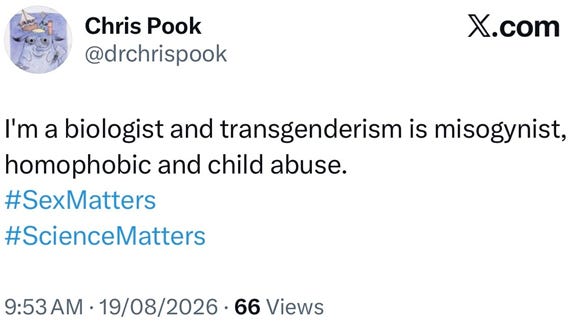
UoA SEEN’s stated values explicitly commit to “upholding the principles of civil and reasoned debate, secularism, pluralism and the universal human rights of all people.” On 19 August, one week before the article ran, Dr Chris Pook, the UoA SEEN chair, posted on X (archived): “I’m a biologist and transgenderism is misogynist, homophobic and child abuse.”
This is not an isolated (archived) incident (archived), as we see from these July posts, where he levels the same accusations directly at people he disagrees with.
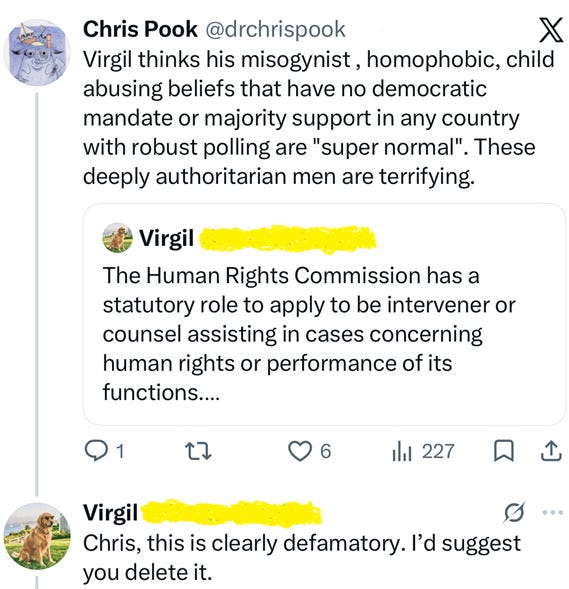
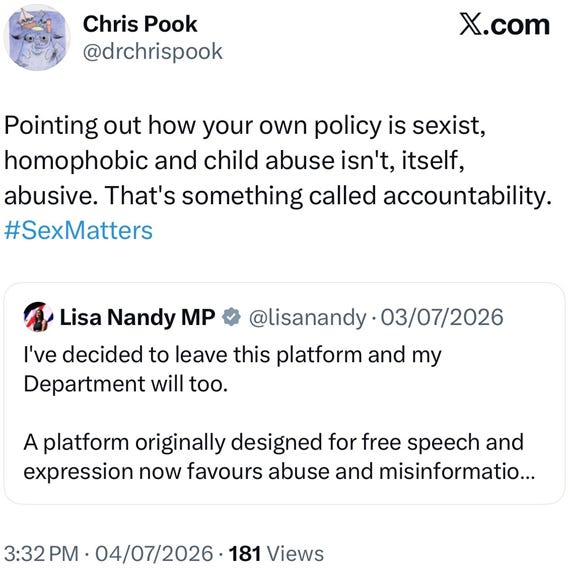
These X posts appear inconsistent with the above UoA SEEN commitments, especially given his role as chair, as well as Pook and Schaletzky’s own asserted rule. Their article says scientific credentials “impose a greater obligation to separate evidence from ideology” and “do not make unsupported assertions scientific.” Placing “I’m a biologist and …” as a credential in front of assertions biology cannot support is the exact misuse the article condemns, committed by one of its authors a week earlier.
Pook and Schaletzky call their position “the underlying biological reality” and Bowatte and Soar’s “false claims” and “quackery.” This rhetoric is consistent with what psychologists call naïve realism: one’s own subjective view is presented as reality itself, and any disagreement must be ignorance, irrationality or bias. Whatever Pook and Schaletzky privately believe, their article is written as if it were true.
They claim that Bowatte and Soar blended “advocacy terminology until a political position appears to be a scientific conclusion.” That sentence comes in their third paragraph, before a single claim has been tested. Their fourth goes further: “Racial theorists used pseudoscience to manufacture biological hierarchies. Eugenicists dressed prejudice in the language of heredity.” Bowatte and Soar, we are told, share “a method” with them. Pook and Schaletzky add that these are “not morally equivalent,” but a disclaimer added after so dark a comparison does not withdraw it, an example of poisoning the well.
What follows makes it worse. Strip out the rebuttals of claims Bowatte and Soar never made, and what remains is what they did say: that sex characteristics vary and don’t always line up, and that the two-sex model’s categorisation is too neat for the law. Pook and Schaletzky never show that this is wrong. They concede the variation in the same paragraph. The only explanation they offer for Bowatte and Soar’s supposed error is the motive supplied at the start: politics dressed as science. This is what C.S. Lewis called Bulverism: assume your opponent is wrong, then explain the error by their motives instead of demonstrating the error.
Bowatte and Soar did invoke race science and eugenics, but as an argument. Their claim was that the bill uses “biological reality” to decide who counts in law, a pattern of “dehumanisation disguised as scientific classification” that produces “institutional discrimination against trans, intersex, non-binary, and takatāpui communities.” Scientific racism was exactly that: biology used to settle whose standing in society could be restricted. Pook and Schaletzky never engage this argument. They turn it back on the people who made it, and aim it at an article that classifies no one and restricts no one’s rights.
In conclusion
So the record stands. Pook and Schaletzky repeatedly alter the claims they set out to refute. The supporting link leads to an advocacy submission they signed. Their article treats scientific disagreement as evidence of political distortion. Recognising gender identity in law takes nothing from biology. Sex remains just as real as before.
Pook and Schaletzky titled their reply “Science is not a political prop.” Thirteen paragraphs of biology advancing a position on gender identity that biology cannot reach or support, coming from two biochemists whose submission says they take no position: now that is a political prop.