

A rebuttal of my work was published (archived) last year by "Lesbian Resistance." It critiques a series of four articles I wrote, occasioned by my recent analysis of patterns in responses to the Law Commission's Ia Tangata report and references three earlier articles responding to content by Hamish McGregor, Jan Rivers, and Penny Marie.
A Note on Compliments, Cleverness, and Caricatures
Before we begin, a brief comment on my critic's opening remarks. She accuses my work of being, in her words, "as usual, dressed up as careful reasoning," and my use of the "straw woman" pun as an "attempt at cleverness" that is "nothing but a performance."
First, a word of thanks. I do, in fact, work very hard at careful reasoning in my articles, and it's gratifying to see that effort acknowledged, however grudgingly. I must also confess to a writer's satisfaction with the "straw woman" turn of phrase. I recognise that it may have been grating (for some) but a double entendre that spoke directly to my central, evidence-backed claim that four women were deploying straw man fallacies was simply too compelling for this writer to pass up. Mea culpa.

Most helpfully, she bestows upon me the caricature of a "finger-wagging" and "maddening" "schoolmaster scolding obstinate students." This is a fine piece of name-calling. And I felt it provided the perfect frame for the rest of this article. To (mis)quote gay activist Jonathan Blake of LGSM in the movie Pride, played by Dominic West:
"There is a long and honourable tradition in the gay community and it has stood us in good stead for a very long time. When somebody calls you a name, you take it and you own it."
Her rebuttal is a near-perfect case study in bad-faith argumentation and a catalogue of rhetorical fallacies, making it ideal for a teaching case. Since she says I offer maddening schoolmasterly lectures, let’s have one. Some finger-wagging may be involved.
Class is in session.
How (Not) To Argue
Our lesson today comes by way of computer scientist Paul Graham's seminal 2008 essay, "How to Disagree." Graham's goal was to improve the quality of online discourse by giving us a tool to both make better arguments and more accurately evaluate the ones we read. He created a seven-level hierarchy of disagreement, from the most primitive forms at the bottom to the most sophisticated and powerful at the top.
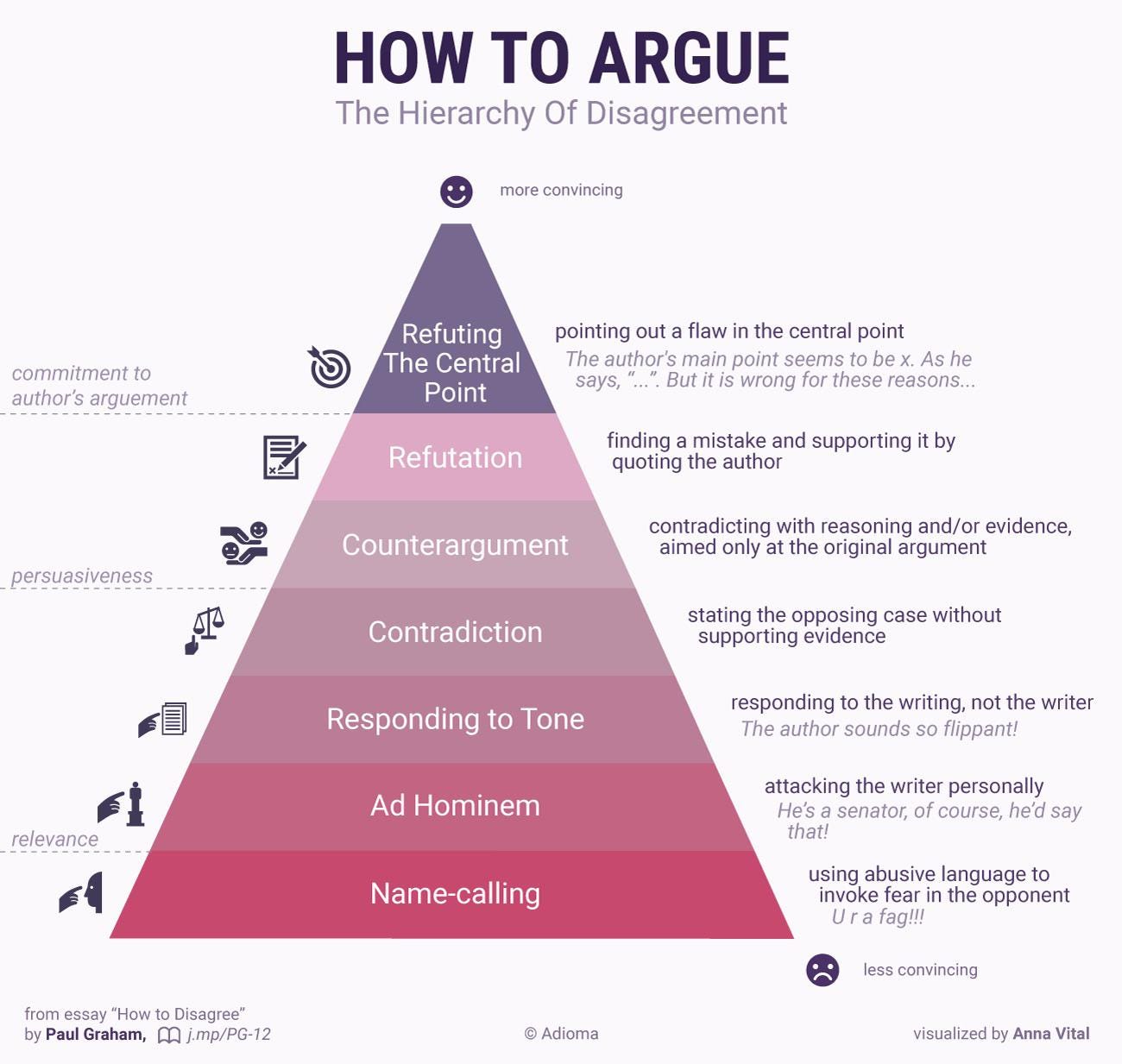
The hierarchy acts as a kind of thermometer for the health of a debate. The lower the average level of disagreement, the more it is just noise and vitriol. The higher the level, the more productive the conversation. Critically, Graham notes that moving up the hierarchy has a powerful effect. While name-calling is easy, actually refuting someone's central point is difficult - but it's also the only way to truly change minds and advance an argument. The hierarchy, therefore, serves as an excellent report card for grading the civility, the actual substance, and the intellectual honesty of any debate.
As an additional teaching aid, here is a helpful video showing the different levels of disagreement applied to a single claim:
Now, let's grade the "Lesbian Resistance" rebuttal against this hierarchy.
DH6/DH5 (Refuting the Central Point / Refutation): The Blank Page
Per Graham, to actually refute an argument, one must engage with its substance. My critic's most serious charge against my work is that I fail to engage with my opponents' actual arguments. She concludes her piece by stating: "If Wilson wanted to debate in good faith, he could start by engaging with what women actually say, not inventing “straw women” he can then demolish."
This claim is factually incorrect. Her rebuttal completely ignores the specific, methodical, point-by-point refutations that form the basis of my work.
Re Hamish McGregor's open letter, I presented four detailed refutations of his claims on Pride's history, child safety, language, and lesbian exclusion, each backed with evidence.
Re Jan Rivers' interview, I dismantled five of her central claims on research, puberty blockers, social contagion, legal challenges, and conversion therapy, citing specific studies and court cases for each.
Re Penny Marie's article, I provided eight distinct, point-by-point rebuttals to her claims, quoting her directly and countering with verifiable facts.
This entire body of work is a direct engagement with "what women [and men] actually say." Her rebuttal neither acknowledged nor addressed any of these.
Grade: F (Did Not Attempt).
DH4 (Counterargument): An Effort in Fallacy
The rebuttal attempts to form counterarguments, but they are built on sand. When I cite the Law Commission's finding of "no evidence" of increased risk in single-sex spaces, she counters that "even only one woman feeling uncomfortable seeing a man in a female-only space is enough." This is not a reasoned argument; it is a textbook appeal to emotion. More damningly, this echoes the same prejudicial logic used to exclude Black women from white spaces during the Jim Crow era and to frame lesbian teachers as a threat to girls during the Briggs Initiative. I even made these very points in the Ia Tangata article. Similarly, she counters the entire psychological consensus on gender identity by declaring, "‘Gender identity’ is not an actual, neutral category of the self, but a belief." This dismisses an entire body of research evidence without providing a substantive alternative, failing the basic requirements of a counterargument.
Grade: D (Attempt made, but reasoning and counter-evidence are limited and historically fraught).
DH3 (Contradiction): Excellence in Repetition
My critic claims "His argumentation is circular, his evidence is selective..." yet her own rebuttal is a model example of the form. The Ia Tangata article, for instance, specifically addressed the false claim that the Law Commission's recommendations would lead to "unchecked entry" into women's refuges. I did this by quoting the report's explicit safeguard: the "welfare-based test," which allows providers to exclude anyone if "reasonably required to protect the welfare of any occupant." Her response? To ignore this detailed refutation and simply repeat the original scare story, claiming gender identity is a "tool used to obscure and ultimately abolish sex." This is not circular reasoning on my part; it is her engaging in argument by repeated contradiction.
Grade: C (For effort. While points are repeated, this doesn't constitute a substantive argument).
DH2 (Responding to Tone): A Point for Accuracy
My critic correctly identifies my tone in certain articles as mocking and sarcastic. Full marks for observation. She possibly fails, however, to grasp that this is a deliberate, context-dependent strategy.
I do not use this tone in more academic pieces. But when facing a "Gish Gallop", a rhetorical firehose of public-facing misinformation, conspiracy theories, and prejudice, a dry response risks dignifying it. Sensational lies often linger in the memory far longer than sober facts.
This is where inoculation matters: present a brief, clearly marked version of the false claim alongside its refutation so readers are resistant when they meet it later. Tone provides the warning; evidence does the work.
Crucially, mockery never replaces substance. It sits on top of point-by-point refutation with sources. The effect is twofold: it frames harmful falsehoods as unworthy of sober debate, and it makes the rebuttal more memorable.
To quote arch-critic Anton Ego from Pixar’s film Ratatouille:
"We thrive on negative criticism, which is fun to write and to read."

Grade: C. (The observation is accurate, though the analysis of its strategic purpose is absent).
DH1 (Ad Hominem): Attacking the Schoolmaster
The rebuttal's central ad hominem is the charge of misogyny. My critic frames my entire project as a man "repackag[ing]" the historical tradition of "pathologis[ing] women when we refuse to accept men’s definitions of us." To support this, she makes the claim that I frame dissenting women as "psychologically defective." She provides no quote for this because I have never used those words.
My method is to critique poor reasoning, misinformation, and conspiratorial thinking by citing my opponents' own words. Calling someone a conspiracy theorist is not an insult when their behaviour fits the definition; it is a description. But people often treat such stigmatised terms, like anti-vaxxer, conspiracy theorist, or prejudiced, as insults to protect their self-esteem. This is a textbook example of the shame deflection I interviewed social psychologist Dr. Carol Jaspers about here.
This is also part of a common deflection and silencing tactic: men who challenge gender-critical arguments are labelled misogynists, while women who do so are dismissed with gendered slurs like ‘handmaiden’. Her accusation is a deliberate conflation of a critique of behaviour and arguments with an attack on womanhood. However, I also critique gender-critical men for the same things.
The most telling proof that this is a bad-faith charge lies in her own reading given that she appears to know of my critique of Hamish McGregor's open letter, yet she conveniently omits his name to support the misogyny impression. The simple reason I write more detailed refutations of gender-critical women is that they are the ones producing the long-form articles that warrant it. Much of the output from their male counterparts, Hamish excepted, consists of low-effort X (formerly Twitter) posts and veiled slurs which I rebut on that platform instead.
Grade: A (Textbook execution of this particular fallacy).
DH0 (Name-calling): Excellence in Playground Tactics
At the bottom of Graham's hierarchy lies the simplest and least persuasive tactic: the direct insult. Here, the rebuttal excels, dismissing my work as a mere "performance" and me as a self-appointed "lone arbiter of intellectual rigour." The entire project is waved away as little more than "pop-psych jargon and Substack varnish." These are textbook examples of mere insult, as they make no attempt to engage with the argument, opting instead to attack the author's character and perceived motives.
Grade: A (Thorough display of primitive rhetoric).
Off the Grading Scale: Academic Misconduct
I did say there would be some finger-wagging. Some tactics are so dishonest they don't even appear on Graham's hierarchy of good-faith disagreement. They represent a complete abandonment of intellectual honesty.
The most serious example is not just a single lie, but a combination of a central falsehood and a deliberate strategy to hide it.
First, the lie. My critic concludes her piece by stating: "If Wilson wanted to debate in good faith, he could start by engaging with what women actually say, not inventing “straw women” he can then demolish." This is a demonstrably false claim. We know she has read my articles; she comments on their tone and style throughout her rebuttal. She therefore knows that my method is the literal opposite of inventing "straw women." I build my case on direct engagement with my opponents' own words, using eight direct quotes in my critique of Penny Marie and even including a screenshot of a fabricated quote from the Women's Rights Party to prove their misrepresentation.
How can an author make a demonstrably false claim and expect to get away with it? The answer is the second part of the strategy: obfuscation. My articles consistently link to the sources I critique. She can lie about my articles because her rebuttal contains zero links to any of mine, preventing her readers from easily discovering her deception.
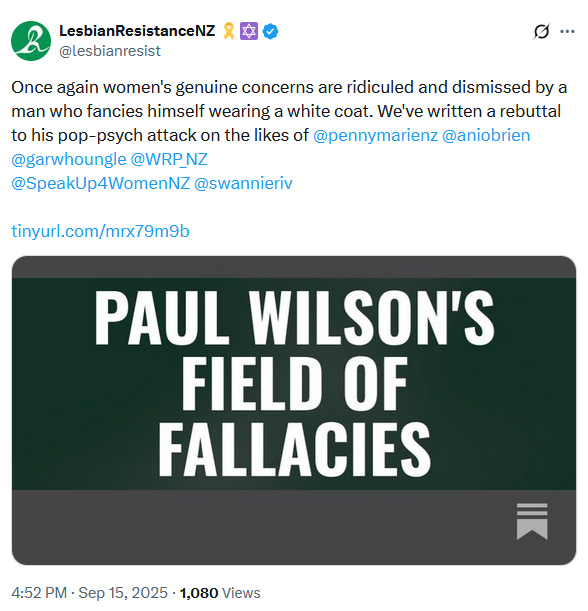
This is compounded by her social media strategy. In her X post announcing her article, she tagged all the gender-critical people I covered (except Hamish) but deliberately omitted my name or handle. It's a clear strategy to prevent the very person she accuses of not engaging from finding her response.
That’s a bit naughty and might warrant a referral to the Dean’s office, but your schoolmaster is forgiving. As Mr Bennet reminds us in Pride and Prejudice, Jane Austen’s masterwork:
“For what do we live, but to make sport for our neighbours, and laugh at them in our turn?”

Final Report Card and Conclusion
As the detailed analysis above shows, the "Lesbian Resistance" rebuttal is a masterclass not in argumentation, but in its avoidance. It receives top marks for its execution of the lowest forms of disagreement while completely failing to engage with the substantive, evidence-based refutations that formed the core of my articles. It is a powerful case study in how to perform the illusion of a rebuttal without ever landing a single, evidence-based blow.
Top marks for DH0/DH1. No attempt at DH5/DH6. The work submitted does not meet the assignment criteria.
Class dismissed.
As an retired English teacher I'll give you an A and raise it to an A+ for quoting Jane Austen. Not sure if finger wagging works though.